What are reasonable adjustments for disabled tenants?
A reasonable adjustment is a change a landlord may be required to make so that a disabled person is not placed at a substantial disadvantage compared with someone who is not disabled. This is not simply good practice; it is a legal duty arising under the Equality Act 2010, specifically section 20 and Schedule 4, which apply to those who let or manage residential property.
It is important to distinguish this obligation from the Renters' Rights Act 2025. While the Renters' Rights Act introduced significant reforms to the private rented sector, including the abolition of assured shorthold tenancies and Section 21, it did not create the legal duty to make reasonable adjustments. That responsibility continues to arise solely under the Equality Act 2010.
The Renters' Rights Act may affect disabled tenants in other ways, for example through the new pet request process for assistance animals and the prohibition of certain discriminatory letting practices. However, these reforms are separate from the statutory duty to make reasonable adjustments.
The Equality Act 2010 protects people who meet the legal definition of disability. A person is generally considered disabled if they have:
- A physical or mental impairment.
- An impairment that has a substantial adverse effect on their ability to carry out normal day-to-day activities.
- An impairment that is long term, meaning it has lasted, or is expected to last, at least 12 months.
Protected conditions
The Act also provides protection from the point of diagnosis for certain conditions, including:
- Cancer.
- HIV.
- Multiple sclerosis.
In addition, people who have previously had a qualifying disability remain protected under the legislation.
For landlords, the duty to consider reasonable adjustments generally arises when:
- A tenant requests an adjustment.
- The tenant's disability and need for an adjustment are otherwise brought to the landlord's attention.
- The landlord knows, or could reasonably be expected to know, that the tenant is disabled and may be placed at a substantial disadvantage without an adjustment.
Understanding where this legal duty comes from is important. Many landlords mistakenly believe reasonable adjustments were introduced by the Renters' Rights Act 2025, when in fact the obligation has existed under the Equality Act 2010 for many years.
Are reasonable adjustments limited to disability?
The duty to make reasonable adjustments under the Equality Act 2010 applies only where a person meets the definition of having a disability. There is no equivalent legal duty to make reasonable adjustments for a tenant who is not disabled.
Where a non-disabled tenant requests the same change for reasons of preference or convenience, the landlord is not legally required to agree. The landlord may still choose to accommodate the request, but this would be a commercial or tenancy management decision rather than a statutory obligation.
Although landlords do not operate in exactly the same way as a service provider dealing with the general public, the Equality Act 2010 still imposes duties in relation to the letting and management of residential property.
There are limited exceptions. Under Schedule 5 of the Equality Act 2010, the reasonable adjustments provisions may not apply where a landlord lets a property that was previously their principal home, provided they do not use a professional property manager or letting agent. Exemptions may also apply to certain small premises where the landlord or a close relative lives on site.
Most private landlords operating rental properties as a business will fall within the scope of the legislation. Where a letting agent or professional manager is involved, the relevant duties may apply regardless of whether the property was previously the landlord’s home.
Landlords should not refuse consent to a proposed adjustment without first considering whether the request is connected to a disability and whether the change would be reasonable. Where there is uncertainty about whether an exemption applies, advice should be obtained before the request is refused.
What reasonable adjustments might a landlord need to make?
The duty to make reasonable adjustments is more limited than some landlords may assume. In relation to a let property, it generally concerns changes to policies, tenancy terms or management practices, the provision of certain auxiliary aids, and consideration of requests for adaptations. The precise obligation will depend on the tenant’s disability, the disadvantage they experience and whether the proposed adjustment is reasonable.
Examples of reasonable adjustments may include:
- Amending a no-pets term to allow a disabled tenant to keep a trained assistance dog.
- Accepting rent by a different payment method or on an alternative date where the usual arrangement places the tenant at a substantial disadvantage.
- Providing tenancy information in an accessible format, such as large print, audio or email, for a tenant with a visual impairment.
- Communicating with a tenant who has a learning disability by telephone or in person, rather than relying solely on written correspondence.
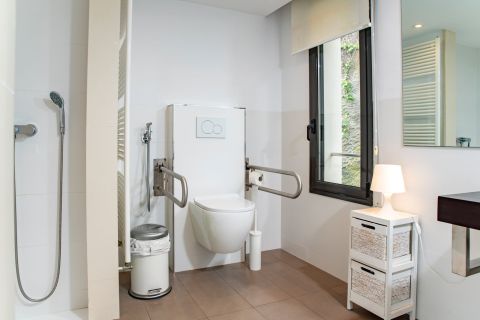
- Providing or replacing an appropriate auxiliary aid, such as a tap turner, portable grab handle or accessible door-entry device.
- Considering consent for a tenant-funded adaptation, such as the installation of a grab rail, through the relevant consent-to-improvements process.
A landlord is not automatically required to agree to every request. Each request should be assessed individually, taking account of its effectiveness, practicality, cost and impact on the property.
Do I have to pay for a disabled tenant's adaptations?
Not always. Whether a landlord is responsible for the cost depends on the type of adjustment being requested.
Where the request relates to changing a policy, tenancy term or management practice, or providing an auxiliary aid, the cost of that reasonable adjustment falls to the landlord. These costs cannot be passed on to the disabled tenant.
By contrast, where the request involves a physical adaptation or alteration to the property, such as installing a ramp or grab rail, the work is generally funded by the tenant. In many cases, financial assistance is available through a Disabled Facilities Grant provided by the local authority. The landlord's role is to consider the request fairly and not unreasonably withhold consent where the consent-to-improvement provisions apply.
Changing a provision, criterion or practice
One type of reasonable adjustment involves changing a provision, criterion or practice, such as a policy, tenancy term or standard management procedure, where it places a disabled tenant at a substantial disadvantage.
Examples include:
- Permitting a trained assistance dog despite a general no-pets policy.
- Providing information in an accessible format.
- Communicating by an alternative method where appropriate.
- Agreeing a different rent payment method or payment date where this removes a substantial disadvantage.
An assistance dog is not treated in law as an ordinary pet. Refusing permission solely because of a blanket no-pets policy may amount to disability discrimination and a failure to make reasonable adjustments. Landlords should also be aware that they cannot impose additional charges or fees because a tenant relies on an assistance dog.
Providing an auxiliary aid
A landlord may also be required to provide a reasonable auxiliary aid where this would remove or reduce a substantial disadvantage experienced by a disabled tenant.
Auxiliary aids are generally portable or non-structural items rather than permanent alterations to the building. Examples may include:
- Portable grab handles.
- Tap turners.
- Accessible door-entry or doorbell systems.
- Appropriate signs or notices.
- Certain items of accessible equipment.
Because these are reasonable adjustments rather than physical alterations to the property, the landlord is generally responsible for meeting the cost where it is reasonable to do so. The Equality Act 2010 prevents landlords from recovering the cost of a reasonable adjustment from the disabled tenant, so these expenses should be treated as part of meeting the landlord's legal obligations.
Physical adaptations and alterations
The duty to make reasonable adjustments does not generally require a landlord to carry out or pay for physical alterations to a let property. This means landlords are not normally obliged to install ramps, stairlifts, widen doorways or make other structural changes as part of their reasonable adjustment obligations under the Equality Act 2010.
Instead, physical adaptations are dealt with through a separate consent-to-improvement process. Under this process, a disabled tenant may submit a written request for consent to carry out a disability-related improvement that would enable them to use or enjoy the property more effectively.
A landlord must not unreasonably withhold consent and may impose reasonable conditions where appropriate. If consent is refused, the reasons should be provided in writing. Where the landlord does not respond within 42 days, the request is treated as having been refused.
In most cases, the tenant is responsible for funding the adaptation, although financial assistance may be available through a Disabled Facilities Grant administered by the local authority. As a result, landlords are not generally expected to meet the cost of disability-related physical adaptations themselves.
- When considering a request, landlords should:
- Assess each application on its individual merits.
- Respond within the required timeframe.
- Provide written reasons if consent is refused.
- Ensure any conditions attached to consent are reasonable and proportionate.
- Keep a written record of the request and the decision reached.
Where a landlord unreasonably withholds consent, the Equality Act 2010 may treat consent as having been given. For this reason, requests should be considered carefully and responded to promptly, with decisions based on objective and justifiable reasons.
What about common areas?
Shared areas, such as a communal entrance hall or stairway, sit outside the obligation for now. The Equality Act 2010 did contain a duty of altering physical features of common parts of let residential premises (section 36), but it has never been commenced in England and Wales. A Government consultation on bringing it into force opened in 2022, yet the provision remains dormant.
In practice, there is currently no legal obligation to adapt communal entrances for disabled people, though the Equality and Human Rights Commission continues to press for it to be activated. If a tenant makes such a request about shared areas, you can explain that no duty is in force.
Should landlords make adjustments for non-disabled tenants?
Because reasonable adjustments are limited to disability, a non-disabled tenant who asks for a change to the property or the tenancy agreement has no legal right to it. A shift worker who wants a later rent date, a family who would like a fence panel replaced, or a tenant recovering from a short illness that does not meet the long-term test: none of these triggers the duty.
That does not mean you should always say no. A reliable tenant who pays on time, respects the property and communicates well is worth keeping, and choosing to accommodate a sensible, reasonable request can be smart business. Think of it as retention rather than obligation. The difference matters. When you are making an adjustment for a disabled tenant, you are meeting a legal duty and cannot charge for it. When you accommodate a non-disabled tenant, you are making a commercial choice on your own terms.
You decide what is reasonable for you, and you can decline without legal risk. Keeping that line clear protects you, and weighing it up is one of the services we provide when a request arrives.
Reasonable adjustments and choosing tenants
The Equality Act 2010 applies not only during a tenancy but also when landlords advertise a property, assess applicants and decide who should be offered the tenancy. A landlord must not reject a disabled applicant, or someone who uses an assistance dog, because of their disability or something arising from it. Doing so may amount to direct discrimination, indirect discrimination or discrimination arising from disability.
In practice, advertising, referencing and selection criteria should be applied consistently across all applicants. A disability should not be treated as a negative factor where the applicant otherwise meets the landlord’s legitimate requirements.
Landlords should also be able to demonstrate that their decision was based on fair, objective and non-discriminatory criteria.
Useful records may include:
- A written list of the criteria used to assess every applicant.
- Copies of the property advert and application form.
- Referencing results, affordability checks and landlord references.
- Notes showing how each applicant was assessed against the same criteria.
- Written reasons for the final decision.
- Records of any adjustment requested during the application process and how it was considered.
- Communications with the letting agent where an agent handled the application.
For example, a landlord may lawfully choose between applicants based on affordability, satisfactory references, proposed move-in date or the suitability of the tenancy terms, provided those criteria are applied consistently and do not place disabled applicants at an unjustified disadvantage.
Informal or subjective reasons should be avoided. Statements such as believing one applicant may be “easier to manage” can be difficult to justify and may create the impression that disability influenced the decision.
Where a disabled applicant requests a change to the application or viewing process, the landlord or agent should consider whether a reasonable adjustment is required. This may include providing information in an accessible format, allowing additional time to complete forms or changing the method of communication.
Where a letting agent acts on the landlord’s behalf, the landlord should confirm that the agent uses compliant advertising, referencing and selection procedures. Keeping a clear written record of the process is one of the most effective ways to show that the decision was fair, consistent and based on legitimate tenancy considerations.
Does the duty apply in Wales?
The Equality Act 2010, and so the reasonable adjustments requirement, applies across Great Britain, meaning England, Wales and Scotland are all covered. The Renters' Rights Act 2025 tenancy regime, however, applies to England only; in Wales,
tenancies are governed by the Renting Homes (Wales) Act 2016. The core adjustment obligation protecting disabled people applies wherever your property sits, in every local council area.
Can I refuse an assistance dog under a no-pets clause?
An assistance dog is treated as an auxiliary aid, not a pet. Refusing a pet under a blanket no-pets policy is likely to be both a failure to make reasonable adjustments and disability discrimination, risking a complaint. You also cannot charge an additional fee for an assistance dog. Updating your tenancy agreement wording to reflect this is a sensible step.
Are emotional support animals treated like assistance dogs?
Not automatically. UK law gives a trained assistance dog clear standing as an auxiliary aid, but the position on emotional support animals is far less settled, and they are not automatically covered in the same way. Treat any such request on its own facts, and take advice before making a decision if you are unsure.
How AST Assistance can help
Responding to an adjustment or adaptation request correctly protects you from a discrimination complaint and keeps a good tenancy on track. AST Assistance is a landlord consultancy based in Bacup, providing services to landlords across England, Wales and Scotland since 2020. We are not a firm of solicitors: we advise and manage the process for you, and we instruct trusted independent solicitors where legal proceedings or formal paperwork are required.
Our services include assessing whether a disabled person's request means making an adjustment or consenting to adaptations, granting permission where appropriate, and helping you word a fair response.
Where a request escalates towards a dispute or complaint, our team manages it calmly, and we resolve 75% of our cases before involving the courts. For support with tenancy management services, updating your tenancy agreements or wider Renters' Rights Act 2025 compliance services, we can help. You can also read our guide on whether you can refuse a tenant a pet and our landlord compliance checklist.
Request a callback
Faced with a request you are not sure about? Don't decide alone. Contact AST Assistance today on 01706 619954, or request a callback and our team will talk you through your position and the most effective next step.